Introduction
As organizations become increasingly dependent on digital connectivity, the need for secure, reliable, and dedicated communication networks continues to grow. While public internet services and shared satellite platforms provide connectivity for many applications, mission-critical industries often require greater control, security, and predictable performance.
A Private TDMA Satellite Network provides organizations with a dedicated satellite communications environment where bandwidth resources, network management, and security policies are controlled according to their operational requirements.
In 2026, private TDMA networks remain a strategic connectivity solution for industries such as maritime, government, defense, energy, mining, banking, disaster response, and remote enterprise operations—especially in locations where terrestrial infrastructure is limited or unreliable.
What Is a TDMA Satellite Network?
TDMA stands for Time Division Multiple Access. It is a satellite networking technology that allows multiple remote terminals to share satellite bandwidth by transmitting data during assigned time slots.
Instead of every location transmitting continuously, TDMA coordinates communication efficiently by allocating scheduled access to network resources.
A typical TDMA satellite network consists of:
- Central hub or teleport
- Satellite capacity
- Network management system
- Remote VSAT terminals
- Modems and RF equipment
- Monitoring and control platforms
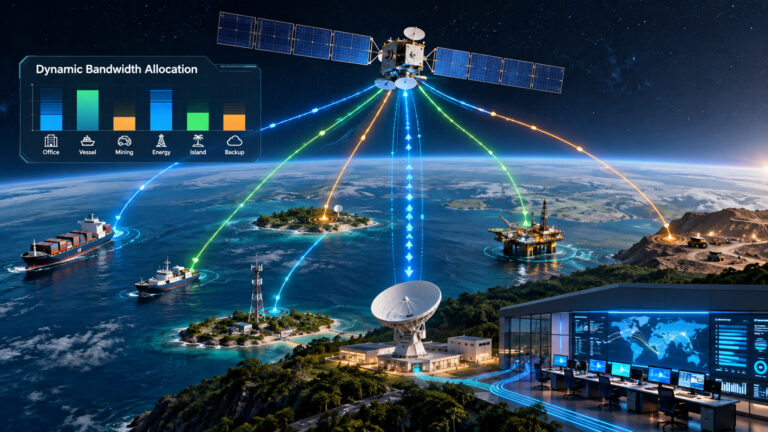
This architecture enables multiple sites, vessels, or remote facilities to communicate securely through a centrally managed satellite network.
What Makes a Private TDMA Network Different?
A shared satellite service typically places many customers on the same infrastructure with limited control over network configuration.
A private TDMA network provides:
Dedicated Network Control
Organizations can define:
- Bandwidth allocation
- Quality of Service (QoS) policies
- Security settings
- Network monitoring rules
- Access permissions
This is important for customers operating critical applications.
Predictable Performance
Private TDMA networks provide greater control over:
- Latency management
- Bandwidth utilization
- Traffic prioritization
- Service availability
Organizations can ensure critical applications receive priority during peak usage periods.
Enhanced Security
Private satellite networks support security requirements through:
- Dedicated network architecture
- Encryption
- Access authentication
- Network segmentation
- Centralized monitoring
This makes them suitable for sensitive operations requiring controlled communications.
How Does a Private TDMA Satellite Network Work?
A simplified architecture includes:
1. Network Operations Center (NOC)
The NOC manages:
- Network performance
- Bandwidth allocation
- Remote terminal monitoring
- Troubleshooting
- Security management
2. Satellite Hub / Teleport
The hub connects the terrestrial network to the satellite system.
Functions include:
- Signal processing
- Traffic management
- Internet or private network interconnection
- Satellite resource management
3. Satellite Capacity
The satellite provides connectivity using:
- C-band
- Ku-band
- Ka-band
The choice depends on:
- Coverage requirements
- Weather conditions
- Bandwidth requirements
- Regulatory environment
4. Remote Terminals
Remote sites may include:
- Maritime VSAT terminals
- Enterprise offices
- Mining sites
- Government facilities
- Island communities
- Offshore platforms
Why Organizations Choose Private TDMA Networks in 2026
1. Mission-Critical Connectivity
Industries cannot afford communication failures.
Private TDMA networks support:
- Emergency communications
- Operational systems
- Remote monitoring
- Business applications
- Safety services
2. Remote Location Coverage
Many operations exist beyond fiber and cellular coverage.
Examples include:
- Ships at sea
- Offshore platforms
- Remote islands
- Mining operations
- Disaster zones
Satellite provides connectivity where terrestrial networks cannot reach.
3. Better Bandwidth Management
Private TDMA allows operators to control bandwidth allocation.
Organizations can prioritize:
High Priority:
- Voice communications
- SCADA systems
- Safety applications
- Enterprise applications
Medium Priority:
- Video meetings
- Business collaboration
Lower Priority:
- General internet access
- Non-critical downloads
Private TDMA Networks for Maritime Communications
The maritime sector is one of the strongest applications for private satellite networks.
Modern vessels require connectivity for:
- Fleet operations
- Navigation support
- Weather information
- Engine monitoring
- Cargo tracking
- Crew welfare
- Cybersecurity
A private TDMA maritime network allows fleet operators to maintain consistent communication across multiple vessels while controlling operational costs.
Private TDMA Networks for Enterprise Connectivity
Enterprises use private satellite networks to connect:
- Remote branches
- Industrial facilities
- Backup locations
- Regional offices
- Critical infrastructure sites
Common applications include:
- Corporate WAN extension
- Disaster recovery
- Secure data communications
- Cloud connectivity
- Remote operations
Integration with Modern Technologies
Hybrid GEO and LEO Networks
In 2026, private TDMA networks are increasingly combined with:
- GEO satellite capacity for broad coverage
- LEO satellites for lower latency
- Terrestrial networks for additional redundancy
This creates flexible hybrid connectivity solutions.
SD-WAN Integration
Private TDMA networks can integrate with SD-WAN platforms to enable:
- Automatic path selection
- Intelligent traffic routing
- Application optimization
- Centralized management
AI-Based Network Management
Artificial intelligence is improving satellite network operations through:
- Predictive fault detection
- Bandwidth optimization
- Automated troubleshooting
- Performance analytics
Private TDMA vs. Public Satellite Services
| Feature | Private TDMA Network | Shared Satellite Service |
|---|---|---|
| Network Control | High | Limited |
| Bandwidth Management | Dedicated policies | Shared resources |
| Security | Higher customization | Standard security |
| Performance Predictability | High | Variable |
| Best For | Mission-critical users | General connectivity |
Key Industries Using Private TDMA Networks
Maritime
- Commercial shipping
- Offshore vessels
- Fishing fleets
- Cruise operations
Energy
- Oil and gas
- Renewable energy
- Remote facilities
Government
- Disaster response
- Public safety
- Remote administration
Mining
- Remote mine operations
- Industrial communications
- Autonomous equipment
Financial Services
- Branch connectivity
- Business continuity
- Disaster recovery
Future of Private TDMA Networks Beyond 2026
Private satellite networks will continue evolving through:
- AI-driven automation
- Multi-orbit connectivity
- Cloud-managed satellite networks
- Advanced cybersecurity
- Software-defined networking
- 5G Non-Terrestrial Networks (NTN)
Rather than being replaced by new satellite technologies, private TDMA networks are expected to become part of broader hybrid connectivity ecosystems.
Conclusion
Private TDMA satellite networks remain a powerful solution for organizations requiring secure, controlled, and reliable communications. In 2026, they continue to support industries where connectivity availability directly impacts safety, operations, and business continuity.
By combining dedicated satellite resources, advanced network management, cybersecurity, AI optimization, and hybrid connectivity options, private TDMA networks provide a foundation for resilient communications across the Asia-Pacific region and beyond.