Introduction
When designing a private satellite communications network, one of the most important decisions is how bandwidth will be allocated on the return link.
Two of the most established approaches are:
TDMA — Time Division Multiple Access
and
SCPC — Single Channel Per Carrier
Both technologies remain relevant in 2026.
The important question is not which technology is universally better.
The real question is:
Which architecture provides the best combination of performance, scalability, reliability and cost for your particular network?
For enterprises, telecommunications operators, maritime organizations, governments and remote infrastructure operators, understanding the differences can significantly affect the design and economics of a satellite network.
1. What Is TDMA?
TDMA allows multiple remote terminals to share satellite capacity by transmitting during assigned time slots.
A simplified example is:
Terminal A → Time Slot 1
Terminal B → Time Slot 2
Terminal C → Time Slot 3
Terminal D → Time Slot 4
The hub or network controller manages the allocation of bandwidth.
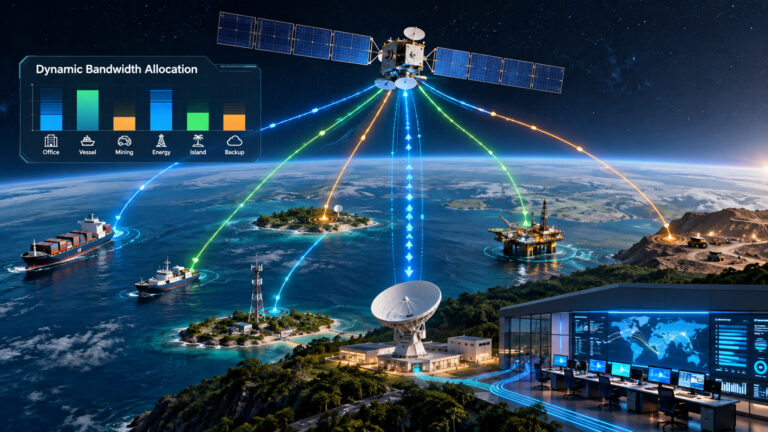
When traffic demand changes, the network can dynamically allocate capacity to different terminals.
For a network with many sites and variable traffic, this can be highly efficient.
2. What Is SCPC?
SCPC gives a terminal its own dedicated carrier.
For example:
Site A → Dedicated carrier
Site B → Dedicated carrier
Site C → Dedicated carrier
The bandwidth is continuously available to the assigned site.
There is no requirement for terminals to wait for an assigned TDMA burst.
This makes SCPC particularly attractive for applications requiring predictable and continuous throughput.
Current industry comparisons continue to describe the fundamental distinction this way: TDMA shares a return carrier among terminals, while SCPC dedicates a carrier to an individual terminal. ([SATCOM Index][2])
3. The Fundamental Difference
The simplest way to understand the difference is:
TDMA
Shared capacity
Multiple terminals use the same satellite resource at different times.
SCPC
Dedicated capacity
A terminal receives its own continuously assigned carrier.
This leads to different characteristics in:
- Bandwidth efficiency
- Scalability
- Predictability
- Cost
- Network management
- Latency
- Traffic behavior
4. TDMA Is Generally Better for Bursty Traffic
Consider a company with 100 branches.
Most branches may not continuously transmit large amounts of data.
Their traffic may look like:
Low → High → Low → Very Low → High
A TDMA network can dynamically allocate capacity according to demand.
Instead of buying dedicated capacity for every branch, the organization can share a common satellite resource.
This can significantly improve overall bandwidth utilization.
5. SCPC Is Better for Continuous High-Demand Traffic
Now consider a headquarters location that continuously requires:
- Voice
- Video
- Cloud applications
- Data replication
- Enterprise traffic
- Critical operational data
If the site requires consistent throughput, a dedicated SCPC link may make more sense.
The organization pays for dedicated capacity rather than competing for shared return-link resources.
6. TDMA for Large Private Networks
TDMA becomes increasingly attractive as the number of remote sites grows.
For example:
10 sites
TDMA can be useful.
50 sites
TDMA becomes more attractive.
200 sites
A shared, centrally managed architecture can provide substantial operational advantages.
500+ sites
Dynamic bandwidth allocation can become particularly valuable.
The exact economics depend on traffic patterns and satellite capacity costs, but the basic principle remains:
More sites + variable traffic = stronger case for shared access.
7. SCPC for High-Availability Applications
SCPC can be attractive for applications where predictable bandwidth is more important than maximizing the number of sites.
Examples include:
- Telecommunications backhaul
- Dedicated enterprise links
- Broadcast contribution
- Critical government communications
- High-volume remote sites
- Point-to-point networks
If a site continuously consumes bandwidth, dedicating a carrier can be operationally straightforward.
8. TDMA and Cost Efficiency
One of the major advantages of TDMA is that satellite capacity can be shared.
Imagine 50 remote locations.
If each site requires 2 Mbps but only uses that bandwidth intermittently, dedicating 2 Mbps continuously to every site could be inefficient.
TDMA allows the network operator to create a shared capacity pool.
The hub dynamically allocates capacity according to demand.
This can reduce the amount of satellite capacity required compared with fully dedicated links.
9. SCPC and Predictability
SCPC’s major advantage is predictability.
If a customer has a dedicated carrier, its performance is largely independent of other remote terminals using the network.
This can be important for:
- Critical applications
- Constant traffic
- Guaranteed throughput
- Certain SLAs
- Dedicated enterprise connectivity
For these applications, the additional cost of dedicated capacity may be justified.
10. What About MF-TDMA?
Modern private satellite networks frequently use MF-TDMA — Multi-Frequency Time Division Multiple Access.
Instead of using one carrier and simply dividing time slots, the network can allocate both:
Frequency + Time Slot
This provides the network controller with greater flexibility.
For example:
Frequency 1 / Slot 1 → Site A
Frequency 1 / Slot 2 → Site B
Frequency 2 / Slot 1 → Site C
Frequency 2 / Slot 2 → Site D
The result can be a more flexible shared-access network.
11. DVB-S2X and DVB-RCS2
Private TDMA networks are also evolving with newer satellite standards.
DVB-S2X is used for high-efficiency forward links, while DVB-RCS2 provides return-channel capabilities.
In 2026, DVB-RCS2 was updated with enhanced capabilities, including support for NGSO systems and configurable waveforms. ([DVB][1])
DVB’s 2026 NGSO simulations also evaluated DVB-S2X and DVB-RCS2 against 5G NR approaches for LEO and MEO systems. DVB reported strong performance for high-traffic fixed connectivity applications. ([DVB][3])
This is important because it means the evolution of TDMA-based satellite networking is not limited to traditional GEO VSAT.
12. TDMA Is Not an “Old Technology”
With the growth of LEO networks, some customers may ask:
“Why should I consider TDMA when LEO satellite is available?”
The answer is that they solve different problems.
LEO is primarily an orbital connectivity architecture.
TDMA is an access and bandwidth-management technology.
They are not necessarily competing concepts.
Future satellite networks can combine:
LEO + TDMA
or
GEO + TDMA
or
GEO + LEO + TDMA + terrestrial networks.
DVB’s 2026 work specifically demonstrates that DVB-S2X/RCS2 technology is being adapted for NGSO environments. ([DVB][4])
13. Private TDMA vs. Public Satellite Broadband
Another important distinction is between a private managed network and a public broadband service.
A private TDMA network can provide:
- Centralized control
- Defined bandwidth policies
- Customer-specific QoS
- Controlled terminal access
- Traffic prioritization
- Private network addressing
- Network monitoring
This can be particularly valuable for organizations that need to control their communications environment.
14. TDMA for Telecommunications Backhaul
Telecommunications operators can use TDMA when multiple remote sites have variable traffic.
For example:
100 remote cellular sites
Traffic varies throughout the day.
A centralized satellite network can dynamically allocate bandwidth according to traffic demand.
This is potentially more efficient than dedicating large amounts of satellite capacity to every site.
For very high-throughput, continuously loaded sites, however, SCPC or another dedicated architecture may be more appropriate.
15. TDMA for Maritime Communications
Maritime networks are another interesting application.
A shipping company may operate:
- 20 vessels
- 50 vessels
- 100+ vessels
Each vessel’s traffic varies.
During operational periods, bandwidth demand may increase.
During other periods, demand may decline.
A shared-access architecture can help aggregate this variable traffic.
However, maritime networks also increasingly use LEO and multiple connectivity providers.
A modern maritime architecture could therefore be:
LEO
GEO/TDMA
LTE/5G
L-band
SD-WAN
This provides both performance and resilience.
16. TDMA for Remote APAC Networks
Asia-Pacific presents a strong use case for private satellite networks.
Potential applications include:
- Remote islands
- Mining
- Offshore energy
- Telecommunications
- Government
- Maritime
- Disaster recovery
- Remote enterprise branches
A private TDMA network can allow a central NOC to manage hundreds of remote terminals.
This is particularly valuable where terrestrial infrastructure is unavailable or unreliable.
17. TDMA and Satellite Backup
TDMA can also be used as part of a backup architecture.
For example:
Primary
Fiber
↓
Secondary
5G
↓
Satellite Backup
Private TDMA
↓
Additional Resilience
LEO
This can create a multi-layer connectivity strategy.
The objective is not simply to provide Internet access.
The objective is to maintain business continuity.
18. TDMA vs. SCPC Comparison
| Factor | TDMA / MF-TDMA | SCPC |
|---|---|---|
| Bandwidth | Shared | Dedicated |
| Number of sites | Excellent for many sites | Better for individual/high-demand sites |
| Bursty traffic | Excellent | Less efficient |
| Continuous traffic | Good | Excellent |
| Predictability | Depends on network design | High |
| Scalability | Excellent | More capacity-intensive |
| Capacity efficiency | High for variable traffic | High for constant traffic |
| Central management | Strong | Straightforward |
| Cost per remote site | Often lower for shared traffic | Often higher |
| Best use | Many variable-demand sites | Dedicated high-demand links |
The actual economics depend on satellite capacity pricing, terminal costs, network topology and traffic profiles.
19. When Should You Choose TDMA?
TDMA is particularly attractive when you have:
- Many remote sites
- Variable traffic
- Shared capacity requirements
- Centralized network management
- Different customer/service classes
- Bursty IP traffic
- A need to scale the number of terminals
A typical example:
100 enterprise branches across APAC
with traffic that varies significantly throughout the day.
20. When Should You Choose SCPC?
SCPC is particularly attractive when you have:
- One or a small number of high-demand sites
- Continuous traffic
- Predictable bandwidth requirements
- Dedicated capacity requirements
- Point-to-point connectivity
- High-throughput applications
A typical example:
A major telecommunications gateway requiring continuous dedicated capacity.
21. Why the Future May Be Hybrid
The most interesting development is that operators do not necessarily have to choose only one technology.
A modern satellite network can combine different access methods.
For example:
High-demand site
SCPC
Medium-demand sites
MF-TDMA
Mobile users
LEO
Near-shore maritime
5G
Emergency backup
GEO satellite
This creates a hybrid satellite network.
22. Software-Defined Satellite Networks
Software-defined modems and network platforms are making hybrid architectures increasingly practical.
Modern systems can potentially support multiple waveforms and dynamically manage capacity.
The broader industry is moving toward architectures in which existing DVB-S2X infrastructure can coexist with newer 5G NTN systems, including software-defined approaches. APSCC’s 2026 discussion describes multi-waveform architectures that preserve existing DVB-S2X/MF-TDMA infrastructure while introducing 5G NTN. ([APSCC][5])
This could reduce the need to completely replace an existing satellite network when new technologies become available.
23. The Role of the Network Operations Center
The NOC becomes particularly important in a private TDMA network.
The operator can monitor:
- Terminal status
- Bandwidth utilization
- Signal quality
- Latency
- Packet loss
- Capacity demand
- Alarms
- Equipment performance
The NOC can then optimize the network.
This is one of the biggest differences between simply buying satellite broadband and operating a managed private satellite network.
24. AI and the Future of TDMA
AI can further improve dynamic bandwidth allocation.
A future system could learn:
Monday
High traffic at 09:00
Tuesday
Similar demand
Wednesday
Similar demand
The network can then predict capacity requirements.
Instead of responding only after congestion occurs, the system can proactively allocate resources.
The future could therefore become:
TDMA + AI + SD-WAN + Multi-Orbit Connectivity
25. The Decision Should Start With Traffic
The most important question when selecting TDMA or SCPC is not:
“Which technology is newer?”
Instead ask:
“What does the traffic actually look like?”
Analyze:
- Number of sites
- Average bandwidth
- Peak bandwidth
- Peak duration
- Application types
- Required SLA
- Traffic symmetry
- Geographic distribution
- Growth expectations
The traffic profile should drive the architecture.
26. A Practical APAC Example
Imagine an organization operating 150 sites across Asia-Pacific.
100 small sites
Variable traffic
→ MF-TDMA
40 medium sites
Moderate traffic
→ MF-TDMA with higher dynamic allocation
10 major sites
Continuous high traffic
→ SCPC or dedicated capacity
Remote emergency locations
→ LEO backup
Primary offices
→ Fiber/5G
This is likely to be more efficient than forcing every location onto one access technology.
27. The Future of Private Satellite Networks
The private satellite network of the future is unlikely to be defined by one waveform.
Instead, it may combine:
DVB-S2X
DVB-RCS2 / MF-TDMA
SCPC
LEO
GEO
5G NTN
SD-WAN
AI
The network becomes a platform capable of selecting the most appropriate connectivity technology for each application.
Conclusion
Private TDMA and SCPC remain relevant satellite networking technologies in 2026.
Neither is universally better.
TDMA is generally strongest when many terminals share variable traffic and the operator wants efficient use of common satellite capacity.
SCPC is generally strongest when a site requires dedicated, predictable and continuously available bandwidth.
The most advanced networks are likely to combine both.
With the continuing development of DVB-S2X, DVB-RCS2, NGSO support, software-defined modems and multi-orbit architectures, private satellite networking is evolving rather than disappearing. ([DVB][1])
For APAC enterprises, telecommunications operators, maritime fleets and critical infrastructure, the real opportunity is therefore not simply choosing between TDMA and SCPC.
It is designing a hybrid satellite network in which each technology is used where it makes the most technical and economic sense.