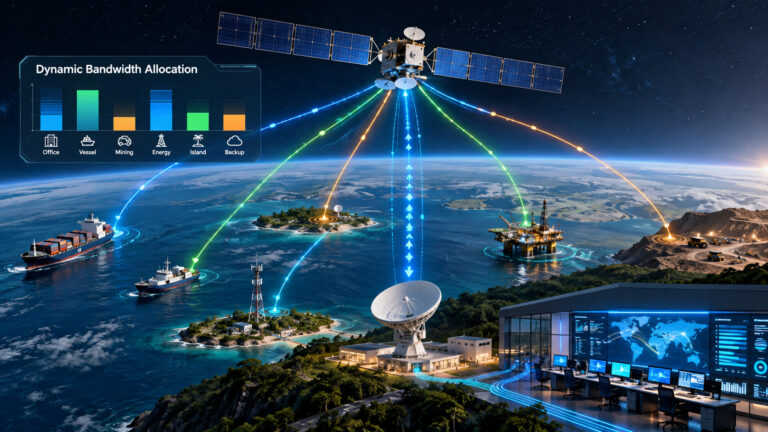
As satellite communications evolve in 2026, Private Time Division Multiple Access (TDMA) networks are experiencing renewed demand from governments, maritime operators, utilities, mining companies, energy providers, and critical infrastructure operators. While Low Earth Orbit (LEO) constellations and Direct-to-Device (D2D) services dominate industry headlines, organizations requiring guaranteed performance, security, and operational control continue to invest in dedicated private satellite networks. (S&P Global)
Why Private TDMA Networks Remain Relevant
Unlike shared broadband services, private TDMA networks provide organizations with:
- Dedicated bandwidth resources
- Predictable network performance
- Enhanced cybersecurity controls
- Centralized network management
- Lower operational costs for large fleets
- Network independence from public internet congestion
For industries where communications are mission-critical, network availability often outweighs raw bandwidth speeds. This is particularly true for maritime, defense, emergency response, oil & gas, and utility sectors. (BCG Global)
Major Trends Driving Private TDMA Growth in 2026
1. Multi-Orbit Network Integration
Organizations increasingly combine GEO, MEO, and LEO satellite capacity within a single private TDMA architecture.
Benefits include:
- Automatic failover between satellite systems
- Improved latency performance
- Greater geographic coverage
- Enhanced disaster recovery capabilities
The satellite industry is moving toward integrated multi-orbit connectivity where customers leverage the strengths of each orbital layer rather than relying on a single network. (Via Satellite)
2. Cyber Resilience Requirements
Cybersecurity has become a major procurement driver.
Private TDMA networks allow operators to implement:
- End-to-end encryption
- Private routing domains
- Network segmentation
- Secure government-grade communications
- Air-gapped operational environments
As cyber threats continue to target critical infrastructure, many enterprises view private satellite networks as part of their cyber resilience strategy. (Deloitte)
3. Growth of Remote Industrial Operations
Mining operations, offshore platforms, renewable energy sites, and remote government facilities require connectivity beyond terrestrial coverage.
Private TDMA networks support:
- SCADA systems
- IoT telemetry
- Remote monitoring
- Asset tracking
- Operational voice services
- Business continuity applications
The expansion of remote industrial infrastructure is creating sustained demand for dedicated satellite communications solutions. (BCG Global)
4. AI-Driven Network Management
Modern TDMA platforms increasingly incorporate artificial intelligence for:
- Traffic optimization
- Dynamic bandwidth allocation
- Predictive maintenance
- Anomaly detection
- Automated fault management
AI-enabled satellite operations help reduce network management costs while improving service availability and efficiency. (arXiv)
Key Industries Adopting Private TDMA Networks
Maritime
Commercial shipping fleets use private TDMA networks for:
- Vessel operations
- Crew welfare services
- Fleet management
- Compliance reporting
- Backup communications
Government and Defense
Government agencies require:
- Sovereign communications
- Disaster response networks
- Border security systems
- Emergency communications
Utilities
Power, water, and energy operators depend on:
- Grid monitoring
- Pipeline communications
- Remote control systems
- Critical infrastructure management
Mining and Resources
Mining companies utilize TDMA networks for:
- Autonomous operations
- Site communications
- Safety systems
- Equipment monitoring
The Future of Private TDMA Networks
The future is not a choice between TDMA and emerging satellite technologies. Instead, organizations are building hybrid architectures that combine:
- Private TDMA networks
- LEO broadband services
- 5G Non-Terrestrial Networks (NTN)
- Direct-to-Device connectivity
- Cloud-managed network platforms
Industry analysts increasingly view satellite communications as part of an integrated global network architecture rather than standalone systems. Standardization efforts and commercialization of Non-Terrestrial Networks are accelerating this convergence. (S&P Global)
Conclusion
In 2026, Private TDMA networks remain one of the most reliable and secure methods for delivering mission-critical connectivity. While LEO constellations and D2D services expand access to satellite communications, enterprises that require guaranteed service levels, security, and operational control continue to invest in dedicated TDMA infrastructure.
The most successful networks of the future will combine private TDMA capabilities with multi-orbit satellite services, AI-driven management, and resilient cybersecurity frameworks—creating highly available communications platforms capable of supporting critical operations anywhere in the world. (Via Satellite)